

I am a big fan of strategy games that allow you to zoom all the way out so that you can see the entire map. This creates a seamless transition between different scales of management and a stronger sense of situational awareness. I want this same experience for Arborlands.
Additionally, I want Arborlands to have a prominent role for scouting and exploration. Arborlands is a game about a pre-stone age animal culture that is just beginning to explore its world and make sense of it. This means uncertainty and incomplete knowledge should play a large role in the game.
These two aspects – scaling management and imperfect knowledge – come together in Arborlands’ “mapification” feature. When an area in the game mapifies, it switches from a detailed, full-color view to a simplified symbol – like ones you would see on an old map.
The idea behind mapification is to give the player an idea of the scale of the full map while also serving as a reminder that one cannot have perfect knowledge of the entire landscape.
Mapification kicks in when the player zooms out to large scales or when a previously explored land is no longer directly viewable.
Despite being able to zoom out to the fullest extent of the map, you lose some detail and resolution of the land in view. Similarly, you may explore large swaths of the map, but you can only directly keep track of lands surrounding your main troop. All explored lands beyond your field of vision will fade into memory as mapified tiles.
My goal is to create a tension between what is known and what can be known. Keeping tabs on one thing means having to divert attention from another. You cannot see the real-time events of the entire map but you can work to expand your field of vision and uncover unexplored curiosities.
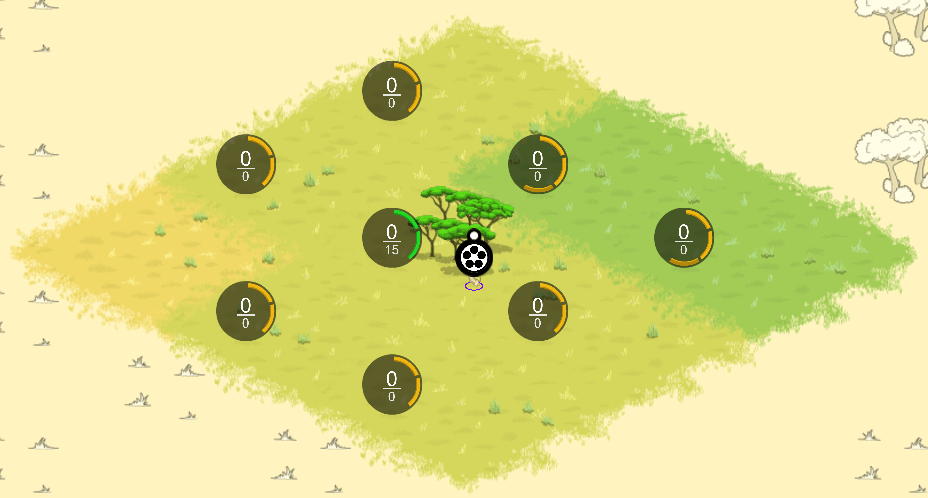
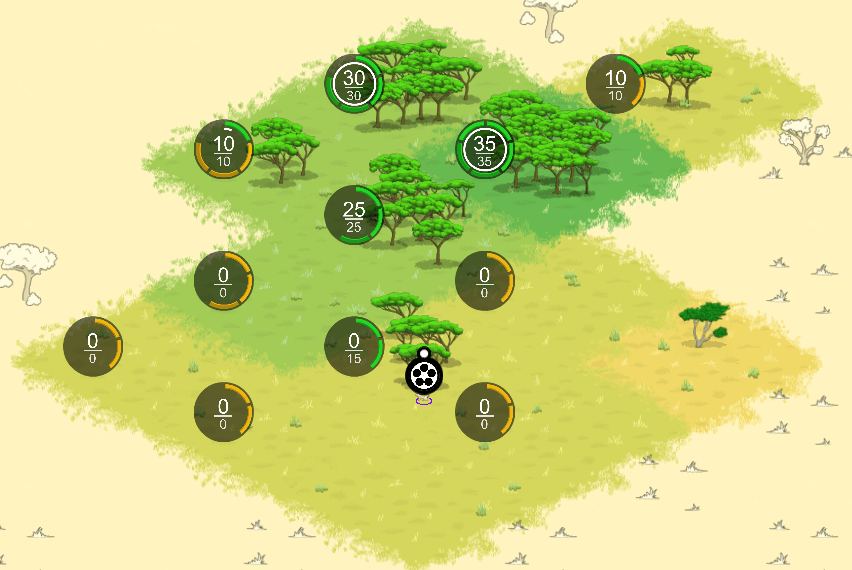
This is a slight spin on the traditional “fog-of-war” you see in other strategy games. But like those games, it creates a scarcity of knowledge. In this way, your field of vision and your ability to directly observe are finite and you must budget them.
The simple rules (lore explanation in italics)
- Land tiles surrounding your main troop are visible. The area immediately surrounding you is visible to you
- Any inhabited lands adjacent to your main troop’s vision are also visible. The Arborins in the inhabited forests relay what they are seeing to you.
- Lands that have not been explored appear blank. You have never been there and no one you know has ever told you about these places.
- Lands that have been explored but are no longer in view are mapified. You or someone you know has been to this place, there is a collective memory of its existence as it was when it was last seen.
- When zoomed out to a certain height, all lands mapify. There are two reasons for this
- It easier to look at and scrutinize
- It has a positive effect on game performance by reducing rendered details
Stay tuned for more features to be discussed in future! 🌟
 Arborlands